通过LDAP初步理解JNDI

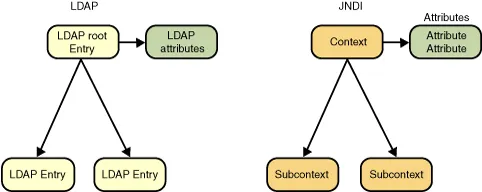
LDAP与JNDI模型对比
jndi-ldap-model

1、LdapBinder
这个类的主要功能是,把消息放到一个预设的LDAP路径

package com.neohope.jndi.test;

import javax.naming.Binding;
import javax.naming.Context;
import javax.naming.NamingEnumeration;
import javax.naming.directory.DirContext;
import javax.naming.directory.InitialDirContext;
import java.util.Hashtable;

/**
 * Created by Hansen
 */
public class LdapBinder {

    public static void main(String[] args) {
        try {
            final Hashtable jndiProperties = new Hashtable();
            jndiProperties.put(Context.INITIAL_CONTEXT_FACTORY, "com.sun.jndi.fscontext.RefFSContextFactory");
            jndiProperties.put(Context.PROVIDER_URL, "file:///d:/Downloads/ldap");
            //jndiProperties.put(Context.INITIAL_CONTEXT_FACTORY, "com.sun.jndi.ldap.LdapCtxFactory");
            //jndiProperties.put(Context.PROVIDER_URL, "ldap://localhost:389");
            //jndiProperties.put(Context.SECURITY_PRINCIPAL,"cn=Directory Manager");
            //jndiProperties.put(Context.SECURITY_CREDENTIALS,"password");

            DirContext ctx = new InitialDirContext(jndiProperties);
            NeoLdapMsgRef msgRef = new NeoLdapMsgRef("Ldap Text");
            ctx.bind("cn=anobject", msgRef);
            //ctx.unbind("cn=anobject");

            /*
            NamingEnumeration list = ctx.list("/");
            while (list.hasMore()) {
                NameClassPair nc = (NameClassPair) list.next();
                System.out.println(nc);
            }
            */

            NamingEnumeration list = ctx.listBindings("/");
            while (list.hasMore()) {
                Binding binding = (Binding)list.next();
                System.out.println(binding.getName() + " " +binding.getObject()
                );
            }

            ctx.close();
        } catch (Exception e) {
            e.printStackTrace();
        }
    }
}

2、LdapReader
这个类的主要功能是,从预设的LDAP路径读取消息

package com.neohope.jndi.test;

import javax.naming.Context;
import javax.naming.directory.DirContext;
import javax.naming.directory.InitialDirContext;
import java.util.Hashtable;

/**
 * Created by Hansen
 */
public class LdapReader {

    public static void main(String[] args) {
        try {
            final Hashtable jndiProperties = new Hashtable();
            jndiProperties.put(Context.INITIAL_CONTEXT_FACTORY, "com.sun.jndi.fscontext.RefFSContextFactory");
            jndiProperties.put(Context.PROVIDER_URL, "file:///d:/Downloads/ldap");

            //jndiProperties.put(Context.INITIAL_CONTEXT_FACTORY, "com.sun.jndi.ldap.LdapCtxFactory");
            //jndiProperties.put(Context.PROVIDER_URL, "ldap://localhost:389");
            //jndiProperties.put(Context.SECURITY_PRINCIPAL,"cn=Directory Manager");
            //jndiProperties.put(Context.SECURITY_CREDENTIALS,"password");

            DirContext ctx = new InitialDirContext(jndiProperties);
            NeoLdapMsgRef msgRef = (NeoLdapMsgRef)ctx.lookup("cn=anobject");
            ctx.close();

            System.out.println(msgRef.message);

        } catch (Exception e) {
            e.printStackTrace();
        }
    }
}

3、LdapMonitor
这个类的主要功能是,监视LDAP路径下内容变动

package com.neohope.jndi.test;

import javax.naming.Context;
import javax.naming.directory.DirContext;
import javax.naming.directory.InitialDirContext;
import javax.naming.event.*;
import javax.naming.ldap.UnsolicitedNotificationEvent;
import javax.naming.ldap.UnsolicitedNotificationListener;
import java.util.Hashtable;

/**
 * Created by Hansen
 * 条件所限,没有进行测试
 */
public class LdapMonitor {

    public static void main(String[] args) {
        try {
            final Hashtable jndiProperties = new Hashtable();
            jndiProperties.put(Context.INITIAL_CONTEXT_FACTORY, "com.sun.jndi.ldap.LdapCtxFactory");
            jndiProperties.put(Context.PROVIDER_URL, "ldap://localhost:389");
            jndiProperties.put(Context.SECURITY_PRINCIPAL,"cn=Manager");
            jndiProperties.put(Context.SECURITY_CREDENTIALS,"password");

            DirContext ctx = new InitialDirContext(jndiProperties);
            EventDirContext enentCtx=(EventDirContext)(ctx.lookup("/"));

            NamingListener unsolListener = new UnsolicitedNotificationListener() {
                public void notificationReceived(UnsolicitedNotificationEvent evt) {
                    System.out.println("received: " + evt + ",notification:" + evt.getNotification());
                }

                public void namingExceptionThrown(NamingExceptionEvent evt) {
                    System.out.println(">>> UnsolListener got an exception");
                    evt.getException().printStackTrace();
                }
            };

            NamingListener namespaceListener = new NamespaceChangeListener() {
                public void objectAdded(NamingEvent evt) {
                    System.out.println("objectAdded: " + evt.getOldBinding() + "\n=> " + evt.getNewBinding());
                    System.out.println("\tchangeInfo: " + evt.getChangeInfo());
                }

                public void objectRemoved(NamingEvent evt) {
                    System.out.println("objectRemoved: " + evt.getOldBinding() + "\n=> " + evt.getNewBinding());
                    System.out.println("\tchangeInfo: " + evt.getChangeInfo());
                }

                public void objectRenamed(NamingEvent evt) {
                    System.out.println("objectRenamed: " + evt.getOldBinding() + "\n=> " + evt.getNewBinding());
                    System.out.println("\tchangeInfo: " + evt.getChangeInfo());
                }

                public void namingExceptionThrown(NamingExceptionEvent evt) {
                    System.err.println(">>>NamespaceChangeListener Exception");
                    evt.getException().printStackTrace();
                }
            };

            NamingListener objectListener = new ObjectChangeListener() {
                public void objectChanged(NamingEvent evt) {
                    System.out.println("objectChanged: " + evt.getOldBinding() + "\n\t=> " + evt.getNewBinding());
                    System.out.println("\tchangeInfo: " + evt.getChangeInfo());
                }

                public void namingExceptionThrown(NamingExceptionEvent evt) {
                    System.err.println(">>>ObjectChangeListener Exception");
                    evt.getException().printStackTrace();
                }
            };

            enentCtx.addNamingListener("", EventContext.SUBTREE_SCOPE, unsolListener);
            enentCtx.addNamingListener("", EventContext.SUBTREE_SCOPE, namespaceListener);
            enentCtx.addNamingListener("", EventContext.SUBTREE_SCOPE, objectListener);

            System.in.read();

            //enentCtx.close();
            ctx.close();
        } catch (Exception e) {
            e.printStackTrace();
        }
    }
}

4、NeoLdapMsgRef

package com.neohope.jndi.test;

import javax.naming.NamingException;
import javax.naming.Reference;
import javax.naming.Referenceable;
import javax.naming.StringRefAddr;

/**
 * Created by Hansen
 */
public class NeoLdapMsgRef implements Referenceable {
    public String message = "";

    public NeoLdapMsgRef(String message)
    {
        this.message = message;
    }

    @Override
    public Reference getReference() throws NamingException {
        Reference ref = new Reference(this.getClass().getName(), NeoLdapMsgRefFactory.class.getName(), null);
        ref.add(new StringRefAddr("msg", message));
        return ref;
    }
}

5、NeoLdapMsgRefFactory

package com.neohope.jndi.test;

import javax.naming.*;
import javax.naming.spi.ObjectFactory;
import java.util.Hashtable;

/**
 * Created by Hansen
 */
public class NeoLdapMsgRefFactory implements ObjectFactory {
    @Override
    public Object getObjectInstance(Object obj, Name name, Context nameCtx, Hashtable<?, ?> environment) throws Exception {
        if (obj instanceof Reference) {
            Reference ref = (Reference) obj;
            String msg = (String) ref.get("msg").getContent();
            NeoLdapMsgRef msgRef = new NeoLdapMsgRef(msg);
            return msgRef;
        }
        else {
            return null;
        }
    }
}

LADP常用函数

LADP操作 解释 JNDI函数
Search Search directory for matching directory entries DirContext.search()
Compare Compare directory entry to a set of attributes DirContext.search()
Add Add a new directory entry DirContext.bind(), DirContext.createSubcontext()
Modify Modify a particular directory entry DirContext.modifyAttributes()
Delete Delete a particular directory entry Context.unbind(), Context.destroySubcontext()
Rename Rename or modify the DN Context.rename()
Bind Start a session with an LDAP server new InitialDirContext()
Unbind End a session with an LDAP server Context.close()
Abandon Abandon an operation previously sent to the server Context.close(), NamingEnumneration.close()
Extended Extended operations command LdapContext.extendedOperation()

LADP查询常用符号

o Organization
ou Organizational unit
cn Common name
sn Surname
givenname First name
uid Userid
dn Distinguished name
mail Email address

LADP查询常用操作符

符号 含义 示例 匹配示例
~ Approximate (sn~=Tyagi) Tyagi or variations in spelling
= Equality (sn=Tyagi) Surname of Tyagi only
> Greater than (sn=Tyagi) Any surname that alphabetically follows Tyagi
>= Greater than or equal to (sn>=Tyagi) Any surname that includes or alphabetically follows Tyagi
< Less than (sn Any surname that alphabetically precedes Tyagi
<= Less than or equal to (sn<=Tyagi) Any surname that includes or alphabetically precedes Tyagi
=* Presence (sn=*) All surnames (all entries with the sn attribute)
Substring (sn=Tya*), (sn=*yag*), (sn=Ty*g*) Any matching string, substring, or superstring that matches Tyagi
& And (&(sn=Tyagi) (cn=Sameer Tyagi)) Any entry that matches both surname of Tyagi and a common name of Sameer Tyagi
| Or (|(sn=Tyagi) (cn=Sameer Tyagi)) Any entry that matches either surname of Tyagi or a common name of Sameer Tyagi
! Not (!(sn=Tyagi)) Any entry other than that with a surname of Tyagi

通过JMS初步理解JNDI

JNDI服务模型
jndi-model

1、服务端

package com.neohope.jndi.test;

import javax.naming.Context;
import javax.naming.InitialContext;
import javax.naming.NamingException;
import java.io.IOException;
import java.rmi.RemoteException;
import java.rmi.registry.LocateRegistry;
import java.util.Hashtable;

/**
 * Created by Hansen on 2016/5/4.
 */
public class Server {
    private static InitialContext ctx;

    public static void initJNDI() {
        try {
            LocateRegistry.createRegistry(1234);
            final Hashtable jndiProperties = new Hashtable();
            jndiProperties.put(Context.INITIAL_CONTEXT_FACTORY, "com.sun.jndi.rmi.registry.RegistryContextFactory");
            jndiProperties.put(Context.PROVIDER_URL, "rmi://localhost:1234");
            ctx = new InitialContext(jndiProperties);
        } catch (NamingException e) {
            e.printStackTrace();
        } catch (RemoteException e) {
            e.printStackTrace();
        }
    }

    public static void bindJNDI(String name, Object obj) throws NamingException {
        ctx.bind(name, obj);
    }

    public static void unInitJNDI() throws NamingException {
        ctx.close();
    }

    public static void main(String[] args) throws NamingException, IOException {
        initJNDI();
        NeoMessage msg = new NeoMessage("Just A Message");
        bindJNDI("java:com/neohope/jndi/test01", msg);
        System.in.read();
        unInitJNDI();
    }
}

2、客户端

package com.neohope.jndi.test;

import javax.naming.Context;
import javax.naming.InitialContext;
import javax.naming.NamingException;
import java.util.Hashtable;

/**
 * Created by Hansen
 */
public class Client {
    public static void main(String[] args) throws NamingException {
        final Hashtable jndiProperties = new Hashtable();
        jndiProperties.put(Context.INITIAL_CONTEXT_FACTORY, "com.sun.jndi.rmi.registry.RegistryContextFactory");
        jndiProperties.put(Context.PROVIDER_URL, "rmi://localhost:1234");

        InitialContext ctx = new InitialContext(jndiProperties);
        NeoMessage msg = (NeoMessage) ctx.lookup("java:com/neohope/jndi/test01");
        System.out.println(msg.message);
        ctx.close();
    }
}

3、NeoMessage

package com.neohope.jndi.test;

import java.io.Serializable;
import java.rmi.Remote;

/**
 * Created by Hansen
 */
public class NeoMessage implements Remote, Serializable {
    public String message = "";

    public NeoMessage(String message)
    {
        this.message = message;
    }
}

大家可以看出,在这个简单的例子中:
1、服务端仅仅是把数据生成好,放到了LocateRegistry中。
2、而客户端,通过JNDI查到消息,获取到了对应的数据。
3、LocateRegistry完成了跨JVM/主机通讯的任务

反过来思考一下,对于JNDIL是不是更清楚一些了呢?
那再思考一下,那J2EE容器中的数据源是如何统一管理的呢?

ZooKeeper配置集群

以在同一台机器上的三个节点的集群为例:

1、在每个节点的zoo.cfg增加下面的配置(只给出了变动的部分)

dataDir=D:/Publish/ZooKeeper/node01
clientPort=2181
server.1=localhost:2888:3888
server.2=localhost:2889:3889
server.3=localhost:2888:3888
dataDir=D:/Publish/ZooKeeper/node02
clientPort=2182
server.1=localhost:2888:3888
server.2=localhost:2889:3889
server.3=localhost:2888:3888
dataDir=D:/Publish/ZooKeeper/node03
clientPort=2183
server.1=localhost:2888:3888
server.2=localhost:2889:3889
server.3=localhost:2888:3888

2、在每个dataDir增加一个myid文件,内容分别为1,2,3

3、现在可以启动哦

4、如果是在不同的服务器上,则dataDir、clientPort及2888:3888都不需要变动,localhost换成对应的计算机名称或ip即可。我这里是在一台电脑上运行的,所以要避免路径及端口冲突。

ZooKeeper Queue(Java)

Queue实现了生产者——消费者模式。

1、QueueTest.java

package com.neohope.zookeeper.test;

import org.apache.zookeeper.*;
import org.apache.zookeeper.data.Stat;

import java.io.IOException;
import java.nio.charset.Charset;
import java.util.List;

/**
 * Created by Hansen
 */
public class QueueTest implements Watcher {
    static ZooKeeper zk = null;
    static Object mutex;
    private String root;

    /**
     * 构造函数
     * @param hostPort
     * @param name
     */
    QueueTest(String hostPort, String name) {
        this.root = name;

        //创建连接
        if (zk == null) {
            try {
                System.out.println("Starting ZK:");
                zk = new ZooKeeper(hostPort, 30000, this);
                mutex = new Object();
                System.out.println("Finished starting ZK: " + zk);
            } catch (IOException e) {
                System.out.println(e.toString());
                zk = null;
            }

            // 创建root节点
            if (zk != null) {
                try {
                    Stat s = zk.exists(root, false);
                    if (s == null) {
                        zk.create(root, new byte[0], ZooDefs.Ids.OPEN_ACL_UNSAFE,
                                CreateMode.PERSISTENT);
                    }
                } catch (KeeperException e) {
                    System.out.println("Keeper exception when instantiating queue: "
                                    + e.toString());
                } catch (InterruptedException e) {
                    System.out.println("Interrupted exception");
                }
            }
        }
    }

    /**
     * exists回调函数
     * @param event     发生的事件
     * @see org.apache.zookeeper.Watcher
     */
    synchronized public void process(WatchedEvent event) {
        synchronized (mutex) {
            mutex.notify();
        }
    }

    /**
     * 添加任务队列
     * @param i
     * @return
     */
    boolean produce(int i) throws KeeperException, InterruptedException {
        String s = "element"+i;
        zk.create(root + "/element", s.getBytes(Charset.forName("UTF-8")), ZooDefs.Ids.OPEN_ACL_UNSAFE,
                CreateMode.PERSISTENT_SEQUENTIAL);

        return true;
    }


    /**
     * 从任务队列获取任务
     * @return
     * @throws KeeperException
     * @throws InterruptedException
     */
    int consume() throws KeeperException, InterruptedException {
        Stat stat = null;

        while (true) {
            synchronized (mutex) {
                List<String> list = zk.getChildren(root, true);
                if (list.size() == 0) {
                    System.out.println("Going to wait");
                    mutex.wait();
                } else {
                    //首先进行排序,找到id最小的任务编号
                    Integer min = Integer.MAX_VALUE;
                    for (String s : list) {
                        Integer tempValue = new Integer(s.substring(7));
                        if (tempValue < min) min = tempValue;
                    }

                    //从节点获取任务,处理,并删除节点
                    System.out.println("Processing task: " + root + "/element" + padLeft(min));
                    byte[] buff = zk.getData(root + "/element" + padLeft(min), false, stat);
                    System.out.println("The value in task is: " + new String(buff));
                    zk.delete(root + "/element" + padLeft(min), -1);

                    return min;
                }
            }
        }
    }

    /**
     * 格式化数字字符串
     * @param num
     */
    public static String padLeft(int num) {
        return String.format("%010d", num);
    }

    /**
     * 入口函数
     * @param args
     */
    public static void main(String args[]) {
        String hostPort = "localhost:2181";
        String root = "/neohope/queue";
        int max = 10;
        QueueTest q = new QueueTest(hostPort, root);

        for (int i = 0; i < max; i++) {
            try {
                q.produce(i);
            } catch (KeeperException e) {

            } catch (InterruptedException e) {
            }
        }

        for (int i = 0; i < max; i++) {
            try {
                int r = q.consume();
                System.out.println("Item: " + r);
            } catch (KeeperException ex) {
                ex.printStackTrace();
                break;
            } catch (InterruptedException ex) {
                ex.printStackTrace();
                break;
            }
        }
    }
}

2、尝试运行一下。

ZooKeeper Barrier(Java)

Barrier主要用于ZooKeeper中的同步。

1、BarrierTest.java

package com.neohope.zookeeper.test;

import org.apache.zookeeper.*;
import org.apache.zookeeper.data.Stat;

import java.io.IOException;
import java.nio.charset.Charset;
import java.util.List;

/**
 * Created by Hansen
 */
public class BarrierTest implements Watcher, Runnable {
    static ZooKeeper zk = null;
    static Object mutex;
    String root;
    int size;
    String name;

    /**
     * 构造函数
     *
     * @param hostPort
     * @param root
     * @param name
     * @param size
     */
    BarrierTest(String hostPort, String root, String name, int size) {
        this.root = root;
        this.name = name;
        this.size = size;

        //创建连接
        if (zk == null) {
            try {
                System.out.println("Begin Starting ZK:");
                zk = new ZooKeeper(hostPort, 30000, this);
                mutex = new Object();
                System.out.println("Finished starting ZK: " + zk);
            } catch (IOException e) {
                System.out.println(e.toString());
                zk = null;
            }
        }

        // 创建barrier节点
        if (zk != null) {
            try {
                Stat s = zk.exists(root, false);
                if (s == null) {
                    zk.create(root, new byte[0], ZooDefs.Ids.OPEN_ACL_UNSAFE,
                            CreateMode.PERSISTENT);
                }
            } catch (KeeperException e) {
                System.out.println("Keeper exception when instantiating queue: "
                                + e.toString());
            } catch (InterruptedException e) {
                System.out.println("Interrupted exception");
            }
        }
    }

    /**
     * exists回调函数
     * @param event     发生的事件
     * @see org.apache.zookeeper.Watcher
     */
    synchronized public void process(WatchedEvent event) {
        synchronized (mutex) {
            mutex.notify();
        }
    }

    /**
     * 新建节点,并等待其他节点被新建
     *
     * @return
     * @throws KeeperException
     * @throws InterruptedException
     */
    boolean enter() throws KeeperException, InterruptedException{
        zk.create(root + "/" + name, "Hi".getBytes(Charset.forName("UTF-8")), ZooDefs.Ids.OPEN_ACL_UNSAFE,
                CreateMode.EPHEMERAL);

        System.out.println("Begin enter barier:" + name);
        while (true) {
            synchronized (mutex) {
                List<String> list = zk.getChildren(root, true);

                if (list.size() < size) {
                    mutex.wait();
                } else {
                    System.out.println("Finished enter barier:" + name);
                    return true;
                }
            }
        }
    }


    /**
     * 新建节点,并等待其他节点被新建
     *
     * @return
     * @throws KeeperException
     * @throws InterruptedException
     */
    boolean doSomeThing()
    {
        System.out.println("Begin doSomeThing:" + name);
        //do your job here
        System.out.println("Finished doSomeThing:" + name);
        return true;
    }

    /**
     * 删除自己的节点,并等待其他节点被删除
     *
     * @return
     * @throws KeeperException
     * @throws InterruptedException
     */

    boolean leave() throws KeeperException, InterruptedException{
        zk.delete(root + "/" + name, -1);

        System.out.println("Begin leave barier:" + name);
        while (true) {
            synchronized (mutex) {
                List<String> list = zk.getChildren(root, true);
                if (list.size() > 0) {
                    mutex.wait();
                } else {
                    System.out.println("Finished leave barier:" + name);
                    return true;
                }
            }
        }
    }

    /**
     * 线程函数,等待DataMonitor退出
     * @see java.lang.Runnable
     */
    @Override
    public void run() {
        //进入barrier
        try {
            boolean flag = this.enter();
            if (!flag) System.out.println("Error when entering the barrier");
        } catch (KeeperException ex) {
            ex.printStackTrace();
        } catch (InterruptedException ex) {
            ex.printStackTrace();
        }

        //处理同步业务
        try {
            doSomeThing();
            Thread.sleep(1000);
        } catch (InterruptedException e) {

        }

        //离开barrier
        try {
            this.leave();
        } catch (KeeperException ex) {
            ex.printStackTrace();
        } catch (InterruptedException ex) {
            ex.printStackTrace();
        }
    }

    /**
     * 入口函数
     * @param args
     */
    public static void main(String args[]) throws IOException {
        String hostPort = "localhost:2181";
        String root = "/neohope/barrier";

        try {
            new Thread(new BarrierTest("127.0.0.1:2181", root,"001", 1)).start();
            new Thread(new BarrierTest("127.0.0.1:2181", root,"002", 2)).start();
            new Thread(new BarrierTest("127.0.0.1:2181", root,"003", 3)).start();
        } catch (Exception e) {
            e.printStackTrace();
        }

        System.in.read();
    }
}

2、运行结果(由于Finished enter barier时,第一次同步已经结束了,所以是与Begin doSomeThing混在一起的)

Begin enter barier:001
Begin enter barier:003
Begin enter barier:002

Finished enter barier:001
Begin doSomeThing:001
Finished doSomeThing:001
Finished enter barier:002
Begin doSomeThing:002
Finished doSomeThing:002
Finished enter barier:003
Begin doSomeThing:003
Finished doSomeThing:003

Begin leave barier:002
Begin leave barier:001
Begin leave barier:003
Finished leave barier:002
Finished leave barier:003
Finished leave barier:001

ZooKeeper DataPublisher(Java)

1、DataPublisher.java

package com.neohope.zookeeper.test;

import org.apache.zookeeper.*;
import org.apache.zookeeper.data.Stat;

import java.io.IOException;

/**
 * Created by Hansen
 */
public class DataPublisher {

    public void publishTest(String hostPort,String znode) throws IOException, KeeperException, InterruptedException {
        ZooKeeper zk = new ZooKeeper("localhost:2181", 30000, new Watcher() {
            public void process(WatchedEvent event) {
                //do nothing
            }});

        //删掉节点
        Stat stat =zk.exists(znode, false);
        if(stat!=null)
        {
            zk.delete(znode, -1);
        }

        //开始测试
        zk.create(znode,"test01".getBytes(), ZooDefs.Ids.OPEN_ACL_UNSAFE, CreateMode.PERSISTENT);
        byte[] buff =zk.getData(znode, false, null);
        System.out.println("data is " + new String(buff,"UTF-8"));
        zk.setData(znode,"test02".getBytes(), -1);
        buff = zk.getData(znode, false, null);
        System.out.println("data is " + new String(buff,"UTF-8"));
        zk.delete(znode, -1);
        zk.close();
    }

    public static void main(String[] args) throws IOException, KeeperException, InterruptedException {
        String hostPort = "localhost:2181";
        String znode = "/neohope/test";

        DataPublisher publisher = new DataPublisher();
        publisher.publishTest(hostPort,znode);
    }
}

2、与Zookeeper Watcher配合使用,试一下。

ZooKeeper Watcher(Java)

1、Executor.java

package com.neohope.zookeeper.test;

import org.apache.zookeeper.KeeperException;

import java.io.IOException;
import java.io.UnsupportedEncodingException;

/**
 * Created by Hansen
 */
public class Executor implements Runnable, DataMonitor.DataMonitorListener
{
    DataMonitor dm;

    /**
     * 构造函数
     * @param hostPort  host:port
     * @param znode      /xxx/yyy/zzz
     */
    public Executor(String hostPort, String znode) throws KeeperException, IOException {
        dm = new DataMonitor(hostPort, znode, null, this);
    }

    /**
     * 线程函数,等待DataMonitor退出
     * @see java.lang.Runnable
     */
    @Override
    public void run() {
        try {
            synchronized (this) {
                while (!dm.bEnd) {
                    wait();
                }
            }
        } catch (InterruptedException e) {
        }
    }

    /**
     * 关闭zk连接
     * @see com.neohope.zookeeper.test.DataMonitor.DataMonitorListener
     */
    @Override
    public void znodeConnectionClosing(int rc) {
        synchronized (this) {
            notifyAll();
        }

        System.out.println("Connection is closing: "+ rc);
    }

    /**
     * znode节点状态或连接状态发生变化
     * @see com.neohope.zookeeper.test.DataMonitor.DataMonitorListener
     */
    @Override
    public void znodeStatusUpdate(byte[] data) {
        if (data == null) {
            System.out.println("data is null");
        } else {
            try {
                String s = new String(data,"UTF-8");
                System.out.println("data is "+s);
            } catch (UnsupportedEncodingException e) {
                e.printStackTrace();
            }
        }
    }

    /**
     * 入口函数
     * @param args
     */
    public static void main(String[] args) throws IOException {
        String hostPort = "localhost:2181";
        String znode = "/neohope/test";

        try {
            new Executor(hostPort, znode).run();
        } catch (Exception e) {
            e.printStackTrace();
        }
    }
}

2、DataMonitor.java

package com.neohope.zookeeper.test;

import org.apache.zookeeper.*;
import org.apache.zookeeper.data.Stat;

import java.io.IOException;
import java.util.Arrays;

/**
 * Created by Hansen
 */
public class DataMonitor implements Watcher, AsyncCallback.StatCallback {
    ZooKeeper zk;
    String znode;
    Watcher chainedWatcher;
    DataMonitorListener listener;

    boolean bEnd;
    byte prevData[];

    /**
     * 构造函数,并开始监视
     * @param hostPort          host:port
     * @param znode              /xxx/yyy/zzz
     * @param chainedWatcher   传递事件到下一个Watcher
     * @param listener          回调对象
     */
    public DataMonitor(String hostPort, String znode, Watcher chainedWatcher,
                       DataMonitorListener listener) throws IOException {
        this.zk = new ZooKeeper(hostPort, 30000, this);
        this.znode = znode;
        this.chainedWatcher = chainedWatcher;
        this.listener = listener;

        // 检查节点状态
        zk.exists(znode, true, this, null);
    }

    /**
     * exists回调函数
     * @param event     发生的事件
     * @see org.apache.zookeeper.Watcher
     */
    @Override
    public void process(WatchedEvent event) {
        String path = event.getPath();
        if (event.getType() == Event.EventType.None) {
            // 连接状态发生变化
            switch (event.getState()) {
                case SyncConnected:
                    // 不需要做任何事情
                    break;
                case Expired:
                    // 连接超时,关闭连接
                    System.out.println("SESSIONEXPIRED ending");
                    bEnd = true;
                    listener.znodeConnectionClosing(KeeperException.Code.SESSIONEXPIRED.intValue());
                    break;
            }
        } else {
            //节点状态发生变化
            if (path != null && path.equals(znode)) {
                //检查节点状态
                zk.exists(znode, true, this, null);
            }
        }

        //传递事件
        if (chainedWatcher != null) {
            chainedWatcher.process(event);
        }
    }

    /**
     * exists回调函数
     * @param rc     zk返回值
     * @param path   路径
     * @param ctx    Context
     * @param stat   状态
     *
     * @see org.apache.zookeeper.AsyncCallback.StatCallback
     */
    @Override
    public void processResult(int rc, String path, Object ctx, Stat stat) {
        boolean exists = false;
        if(rc== KeeperException.Code.OK.intValue()) {
            //节点存在
            exists = true;
        }
        else if(rc== KeeperException.Code.NONODE.intValue()){
            //节点没有找到
            exists = false;
        }
        else if(rc==KeeperException.Code.SESSIONEXPIRED.intValue() ){
            //Session过期
            bEnd = true;
            System.out.println("SESSIONEXPIRED ending");
            listener.znodeConnectionClosing(rc);
            return;
        }
        else if( rc==KeeperException.Code.NOAUTH.intValue())
        {
            //授权问题
            bEnd = true;
            System.out.println("NOAUTH ending");
            listener.znodeConnectionClosing(rc);
            return;
        }
        else
        {
            //重试
            zk.exists(znode, true, this, null);
            return;
        }

        //获取数据
        byte b[] = null;
        if (exists) {
            try {
                b = zk.getData(znode, false, null);
            } catch (KeeperException e) {
                e.printStackTrace();
            } catch (InterruptedException e) {
                return;
            }
        }
        //调用listener
        if ((b == null && b != prevData)
                || (b != null && !Arrays.equals(prevData, b))) {
            listener.znodeStatusUpdate(b);
            prevData = b;
        }
    }

    /**
     * Other classes use the DataMonitor by implementing this method
     */
    public interface DataMonitorListener {
        /**
         * znode节点状态或连接状态发生变化
         */
        void znodeStatusUpdate(byte data[]);

        /**
         * 关闭zonde连接
         *
         * @param rc ZooKeeper返回值
         */
        void znodeConnectionClosing(int rc);
    }
}

3、运行Executor

4、运行zkCli.cmd

zkCli.cmd -server 127.0.0.1:2181
[zk: 127.0.0.1:2181(CONNECTED) 1] ls /
[zk: 127.0.0.1:2181(CONNECTED) 2] create /neohope/test test01
[zk: 127.0.0.1:2181(CONNECTED) 3] set /neohope/test test02
[zk: 127.0.0.1:2181(CONNECTED) 4] set /neohope/test test03
[zk: 127.0.0.1:2181(CONNECTED) 5] delete /neohope/test
[zk: 127.0.0.1:2181(CONNECTED) 6] quit

5、观察Executor的输出

Wkhtmltopdf添加页码

为wkhtmltopdf(wkhtmltox)添加页面有两种方式。

第一种为,在下面六个参数中,传递[page]/[topage]即可。

--header-center
--header-left
--header-right
--footer-center
--footer-left
--footer-right

第二种为,为header或footer设置–header-html或–footer-html参数,从而生成页码。

<!DOCTYPE html PUBLIC "-//W3C//DTD XHTML 1.0 Transitional//EN" "http://www.w3.org/TR/xhtml1/DTD/xhtml1-transitional.dtd">
<html xmlns="http://www.w3.org/1999/xhtml" xml:lang="en">
<head>
  <meta http-equiv="Content-Type" content="text/html;charset=UTF-8"/>
  <title>footer</title>
  <script>
  function subst() {
    var vars={};
    var x=window.location.search.substring(1).split('&');
    for (var i in x) {var z=x[i].split('=',2);vars[z[0]] = unescape(z[1]);}
    var x=['frompage','topage','page','webpage','section','subsection','subsubsection'];
    for (var i in x) {
      var y = document.getElementsByClassName(x[i]);
      for (var j=0; j<y.length; ++j) y[j].textContent = vars[x[i]];
    }
  }
  </script>
</head>
<body style="border:0; margin: 0;" onload="subst()">
  <table style="border-bottom: 1px solid black; width: 100%">
    <tr>
      <td style="text-align:right">
        第 <span class="page"></span> 页,共 <span class="topage"></span> 页
      </td>
    </tr>
  </table>
</body>
</html>

Spring通过注解加载Bean的基本原理浅析(C#版)

这第一篇,同样讲的是spring的IOC功能,是如何实现通过注解来加载Bean文件的。
这是java版本的姐妹篇,C#版本。

文章原创,转载请注明出处www.neohope.com

经过无限精简之后,整体流程为:
1、初始化bean工厂
bean工厂根据配置,加载带有指定attribute的类,并放到了Dictionary中
2、从bean工厂获取一个bean
通过bean的id,实例化一个类,并返回

需要的前置知识为:
1、spring的基本知识
2、反射

然后是源码:
1、TestAttribute.cs
这是个Attribute类,声明了一个新的注解类型,用于表示bean及bean的名字

using System;
using System.Collections.Generic;
using System.Linq;
using System.Text;

namespace TestAttribute
{
    [AttributeUsage(AttributeTargets.Class)]
    class TestAttribute : System.Attribute
    {
        public String Ntype { get; set; }
        public String Nname { get; set; }
        public String Nauthor { get; set; }
        public String Nversion { get; set; }
        public String Nmsg { get; set; }
    }
}

2、TestBean.cs
这是个Bean,使用了Attribute作为标识,是用于具体加载的类

using System;
using System.Collections.Generic;
using System.Linq;
using System.Text;

namespace TestAttribute
{
    [TestAttribute(Nname = "testbean", Nauthor = "neohope", Ntype = "BEAN", Nmsg = "this is just a message", Nversion = "1.0")]
    class TestBean
    {
        public String name;
        public int age;
        public String sex;
    }
}

3、ClassPathScanner.cs
通过指定assembly名,扫描assembly下所有的类型

using System;
using System.Collections.Generic;
using System.Linq;
using System.Reflection;
using System.Text;

namespace TestAttribute
{
    /// <summary>
    /// The class path scanner
    /// </summary>
    class ClassPathScanner
    {
        /// <summary>
        /// Get all assemblies in current domain <see cref="System.Reflection.Assembly"/>.
        /// </summary>
        /// <returns>string set of assembly name</returns>
        public static String[] FindAllAssembliesInCurrentDomain()
        {
            List<String> result = new List<String>();
            foreach (System.Reflection.Assembly assembly in System.AppDomain.CurrentDomain.GetAssemblies())
            {
                result.Add(assembly.GetName().Name);
            }

            return result.ToArray();
        }

        /// <summary>
        /// Get all module in current assembly
        /// </summary>
        /// <returns>string set of module name</returns>
        public static String[] FindAllModuleInThisAssembly()
        {
            List<String> result = new List<String>();
            //Assembly thisAssembly = this.GetType().Assembly;
            Assembly thisAssembly = System.Reflection.Assembly.GetExecutingAssembly();
            foreach (Module item in thisAssembly.GetModules())
            {
                result.Add(item.Name);
            }

            return result.ToArray();
        }


        /// <summary>
        /// Get all type in current assembly
        /// </summary>
        /// <returns>string set of type name</returns>
        public static String[] FindAllTypeInThisAssembly()
        {
            List<String> result = new List<String>();
            //Assembly thisAssembly = this.GetType().Assembly;
            Assembly thisAssembly = System.Reflection.Assembly.GetExecutingAssembly();
            foreach (Type item in thisAssembly.GetTypes())
            {
                result.Add(item.Name); 
            }

            return result.ToArray();
        }

        /// <summary>
        /// Get all type in the assembly
        /// </summary>
        /// <param name="assemblyName">the name of the assembly</param>
        /// <returns>Type set in the assembly</returns>
        public static Type[] FindAllTypeInAssemblyByName(String assemblyName)
        {
            Assembly theAssembly = null;
            foreach (System.Reflection.Assembly assembly in System.AppDomain.CurrentDomain.GetAssemblies())
            {
                if (assembly.GetName().Name.Equals(assemblyName))
                {
                    theAssembly = assembly;
                    break;
                }
            }
            if (theAssembly == null) return new Type[] { };

            List<Type> result = new List<Type>();
            foreach (Type item in theAssembly.GetTypes())
            {
                result.Add(item);
            }

            return result.ToArray();
        }
    }
}

4、ClassAttributeScanner.cs
工厂类,初始化时,通过attribute过滤bean,并将bean的名称及type放到dictionary中
获取实例时,通过bean名称,获取type,并实例化,返回

using System;
using System.Collections.Generic;
using System.Linq;
using System.Reflection;
using System.Text;

namespace TestAttribute
{
    internal class ClassAttributeScanner
    {
        /// <summary>
        /// Dictionary of bean name and bean class
        /// </summary>
        private static Dictionary<String, Type> beanDict = new Dictionary<string, Type>();

        /// <summary>
        ///  Load all bean class with attribute from package
        /// </summary>
        /// <param name="assemblyName">the name of the assembly</param>
        /// <returns></returns>
        protected static void loadBeanTypes(String assemblyName)
        {
            Type[] allTypes = ClassPathScanner.FindAllTypeInAssemblyByName(assemblyName);
            foreach (Type aType in allTypes)
            {
                Attribute attribute  = (TestAttribute)Attribute.GetCustomAttribute(aType, typeof(TestAttribute));
                if (attribute == null) continue;

                TestAttribute ta = (TestAttribute)attribute;
                String beanName = ta.Nname;
                beanDict[beanName] = aType;
            }
        }

        /// <summary>
        /// init the bean factory
        /// </summary>
        /// <param name="assemblyName">the name of the assembly</param>
        /// <returns></returns>
        public static void InitBeanFactory(String assemblyName)
        {
            loadBeanTypes(assemblyName);
        }

        public static Object GetBean(String beanName)
        {
            Type theType = beanDict[beanName];
            if (theType != null)
            {
                //return theType.Assembly.CreateInstance(theType.FullName); 
                return Activator.CreateInstance(theType);
            }
            else
            {
                return null;
            }
        }
    }
}

5、Program.cs
程序入口

using System;
using System.Collections.Generic;
using System.Linq;
using System.Text;

namespace TestAttribute
{
    class Program
    {
        private static void Main(string[] args)
        {
            //String[] ret = ClassPathScanner.FindAllAssembliesInCurrentDomain();
            //String[] ret = ClassPathScanner.FindAllModuleInThisAssembly();
            //String[] ret = ClassPathScanner.FindAllTypeInThisAssembly();
            //foreach (string s in ret) Console.WriteLine(s);

            ClassAttributeScanner.InitBeanFactory("TestAttribute");
            TestBean bean = (TestBean)ClassAttributeScanner.GetBean("testbean");
            bean.name = "neohope";
        }
    }
}

文章原创,转载请注明出处www.neohope.com

Spring通过注解加载Bean的基本原理浅析(java版)

最近在看spring的源码,想写一系列的文章,来模拟spring的一些最基本功能的实现。
部分源码是从spring中抽取出来的,然后进行了无限的精简,目的是让入门的弟兄们也可以看得很清楚。
首先这第一篇,就是说的spring的IOC功能中,是如何实现通过注解来加载Bean文件的。

文章原创,转载请注明出处www.neohope.com

经过无限精简之后,整体流程为:
1、初始化bean工厂
bean工厂根据配置,加载带有指定annotation的类,并放到了map中
2、从bean工厂获取一个bean
通过bean的id,实例化一个类,并返回

需要的前置知识为:
1、spring的基本知识
2、反射

然后是源码:
1、TestAnnotation.java
这是个注解类,声明了一个新的注解类型,用于表示bean及bean的名字

package com.neohope.annotation.test;

import java.io.File;
import java.io.IOException;
import java.lang.annotation.*;
import java.net.JarURLConnection;
import java.net.URL;
import java.net.URLConnection;
import java.util.Collections;
import java.util.Enumeration;
import java.util.LinkedHashSet;
import java.util.Set;
import java.util.jar.JarEntry;
import java.util.jar.JarFile;

/**
 * Created by Hansen on 2016/3/10.
 */

@Retention(RetentionPolicy.RUNTIME)
@Target(ElementType.TYPE)
@Documented
public @interface TestAnnotation {
    String ntype();
    String nname();
    String nauthor();
    String nversion();
    String nmsg();
}

2、TestBean.java
这是个Bean,使用了注解作为标识,是用于具体加载的类

package com.neohope.annotation.test;

/**
 * Created by Hansen on 2016/3/10.
 */

@TestAnnotation(nauthor = "neohope",nversion="1.0",ntype = "BEAN",nname = "testbean", nmsg = "this is just a message")
public class TestBean {
    public String name;
    public int age;
    public String sex;
}

3、ClassPathScanner.java
从spring中抽取的,类扫描工具类
其作用为,通过指定包名,扫描包名下所有的类
可用于jar文件中类的扫描

package com.neohope.annotation.test;

import java.io.File;
import java.io.IOException;
import java.net.JarURLConnection;
import java.net.URISyntaxException;
import java.net.URL;
import java.net.URLConnection;
import java.util.Collections;
import java.util.Enumeration;
import java.util.LinkedHashSet;
import java.util.Set;
import java.util.jar.JarEntry;
import java.util.jar.JarFile;

/**
 * Created by Hansen on 2016/3/10.
 */
public class ClassPathScanner {

    /**
     * Get all class name in given packageName
     * @param packageName the package name
     * @return the result as String array
     * @throws IOException in case of I/O errors
     * @see #getAllClassFileInPackage
     */
    public static String[] getAllClassNameInPackage(String packageName) throws IOException, URISyntaxException {
        String[] classFiles = getAllClassFileInPackage(packageName);
        Set<String> result = new LinkedHashSet<String>(classFiles.length);
        for(String clazz : classFiles)
        {
            result.add(clazz.replace(".class", "").replace("/", ".").replace("\\", "."));
        }
        return result.toArray(new String[result.size()]);
    }

    /**
     * Get all class files in given packageName
     * @param packageName the package name
     * @return the result as String array
     * @throws IOException in case of I/O errors
     * @see #findAllClassPathByPackageName
     * @see #loadJarClasses
     * @see #loadFileClasses
     */
    protected static String[] getAllClassFileInPackage(String packageName) throws IOException, URISyntaxException {
        if (packageName.startsWith("/")) {
            packageName = packageName.substring(1);
        }
        if (packageName.endsWith("/")) {
            packageName = packageName.substring(0,packageName.length()-1);
        }

        URL[] rootDirResources = findAllClassPathByPackageName(packageName);
        Set<String> result = new LinkedHashSet<String>(16);
        for (URL rootDirResource : rootDirResources) {
            if (rootDirResource.toString().toUpperCase().startsWith("JAR")) {
                result.addAll(loadJarClasses(rootDirResource));
            }
            else {
                String rootEntryPath = rootDirResource.getPath().replace(packageName,"").replace("/",File.separator).substring(1);
                result.addAll(loadFileClasses(rootDirResource,rootEntryPath));
            }
        }

        return result.toArray(new String[result.size()]);
    }

    /**
     * Find all class path with the given packageName via the ClassLoader.
     * @param packageName the absolute path within the classpath
     * @return the result as URL array
     * @throws IOException in case of I/O errors
     * @see java.lang.ClassLoader#getResources
     */
    protected static URL[] findAllClassPathByPackageName(String packageName) throws IOException {
        ClassLoader cl = ClassPathScanner.class.getClassLoader();
        Enumeration<URL> resourceUrls = (cl != null ? cl.getResources(packageName) : ClassLoader.getSystemResources(packageName));
        Set<URL> result = new LinkedHashSet<URL>();
        while (resourceUrls.hasMoreElements()) {
            URL url = resourceUrls.nextElement();
            result.add(url);
        }
        return result.toArray(new URL[result.size()]);
    }

    /**
     * Get all the class file in given class dir
     * @param rootClassDir the root directory
     * @return all the class in rootClassDir
     * @throws IOException if directory contents could not be retrieved
     */
    protected static Set<String> loadFileClasses(URL rootClassDir, String rootEntryPath) throws IOException, URISyntaxException {
        File rootDir;
        rootDir = new File(rootClassDir.toURI());
        if(!rootDir.exists() || !rootDir.isDirectory() || !rootDir.canRead())
        {
            return Collections.emptySet();
        }

        Set<String> result = new LinkedHashSet<String>(8);
        EnumClassFiles(rootDir, rootEntryPath, result);
        return result;
    }

    /**
     * Recursively get all class files in the given dir
     * @param dir the given directory
     * @param result the Set of class names to add to
     * @throws IOException if directory contents could not be retrieved
     */
    protected static void EnumClassFiles(File dir, String rootEntryPath, Set<String> result) throws IOException {
        File[] dirContents = dir.listFiles();
        if (dirContents == null) {
            return;
        }
        for (File content : dirContents) {
            if (content.isDirectory()) {
                if (!content.canRead()) {
                }
                else {
                    EnumClassFiles(content, rootEntryPath, result);
                }
            }
            else {
                if(content.toString().endsWith(".class")) {
                    result.add(content.toString().replace(rootEntryPath, ""));
                }
            }
        }
    }

    /**
     * Get all the class file in given jar path
     * @param jarPath the given jar path
     * @return the Set of matching Resource instances
     * @throws IOException in case of I/O errors
     */
    protected static Set<String> loadJarClasses(URL jarPath)
            throws IOException {
        JarFile jarFile;
        String jarFileUrl;
        String rootEntryPath = "";
        Set<String> result = new LinkedHashSet<String>(8);

        URLConnection connection = jarPath.openConnection();
        if (connection instanceof JarURLConnection) {
            JarURLConnection jarCon = (JarURLConnection) connection;
            jarFile = jarCon.getJarFile();
            jarFileUrl = jarCon.getJarFileURL().toExternalForm();
            JarEntry jarEntry = jarCon.getJarEntry();
            rootEntryPath = (jarEntry != null ? jarEntry.getName() : "");
        } else {
            return Collections.emptySet();
        }

        try {
            for (Enumeration<JarEntry> entries = jarFile.entries(); entries.hasMoreElements(); ) {
                JarEntry entry = entries.nextElement();
                String entryPath = entry.getName();

                if (entryPath.startsWith(rootEntryPath) && entryPath.endsWith(".class")) {
                    result.add(entryPath);
                }
            }

        } catch (Exception ex) {
        }

        return result;
    }

    public static void main(String[] args) throws IOException, URISyntaxException {
        //String[] classes = getAllClassNameInPackage("com/neohope/annotation");
        //String[] classes = getAllClassNameInPackage("org/apache/log4j/config");

        String[] classes = getAllClassNameInPackage("/com/neohope/annotation/");
        //String[] classes = getAllClassNameInPackage("org/apache/log4j/config");
        for(String clazz : classes)
        {
            System.out.println(clazz);
        }
    }
}

4、ClassAnnotationScanner.java
工厂类,初始化时,通过annotation过滤bean,并将bean的名称及class放到map中
获取实例时,通过bean名称,获取class,并实例化,返回

package com.neohope.annotation.test;

import java.io.IOException;
import java.net.URISyntaxException;
import java.util.HashMap;

/**
 * Created by Hansen on 2016/3/10.
 */

public class ClassAnnotationScanner {

    /**
     * HashMap of bean name and bean class
     */
    static HashMap<String, Class> beanMap = new HashMap<String, Class>();

    /**
     * Load all bean class with annotation from package
     * @param packageName the package name
     * @return void
     * @throws IOException in case of I/O errors
     * @throws URISyntaxException in case of URI syntax error
     * @throws ClassNotFoundException in case of class not found
     * @see ClassPathScanner#getAllClassNameInPackage
     */
    protected static void loadBeanClasses(String packageName) throws IOException, URISyntaxException, ClassNotFoundException {
        String[] classes = ClassPathScanner.getAllClassNameInPackage(packageName);
        for(String clazz : classes)
        {
            Class loadedClazz = Class.forName(clazz);
            Object obj  = loadedClazz.getAnnotation(TestAnnotation.class);
            if(obj==null)continue;

            TestAnnotation ta = (TestAnnotation)obj;
            String beanName = ta.nname();
            beanMap.put(beanName,loadedClazz);
        }
    }

    /**
     * init the bean factory
     * @param packageName the package name
     * @return void
     * @throws IOException in case of I/O errors
     * @throws URISyntaxException in case of URI syntax error
     * @throws ClassNotFoundException in case of class not found
     * @see #loadBeanClasses
     */
    public static void initBeanFactory(String packageName) throws IOException, URISyntaxException, ClassNotFoundException {
        loadBeanClasses(packageName);
    }

    /**
     * get bean by bean name
     * @param beanName the bean name
     * @return new object of the bean class
     * @throws IllegalAccessException in case of illegal access
     * @throws InstantiationException in case of instantiation error
     */
    protected static Object getBean(String beanName) throws IllegalAccessException, InstantiationException {
        Class loadedClazz = beanMap.get(beanName);
        if(loadedClazz!=null) {
            return loadedClazz.newInstance();
        }
        else
        {
            return null;
        }
    }

    public static void main(String[] args) throws IOException, URISyntaxException, ClassNotFoundException, InstantiationException, IllegalAccessException {
        initBeanFactory("com/neohope/annotation/");
        TestBean bean = (TestBean)getBean("testbean");
        bean.name = "neohope";
    }

}

文章原创,转载请注明出处www.neohope.com